
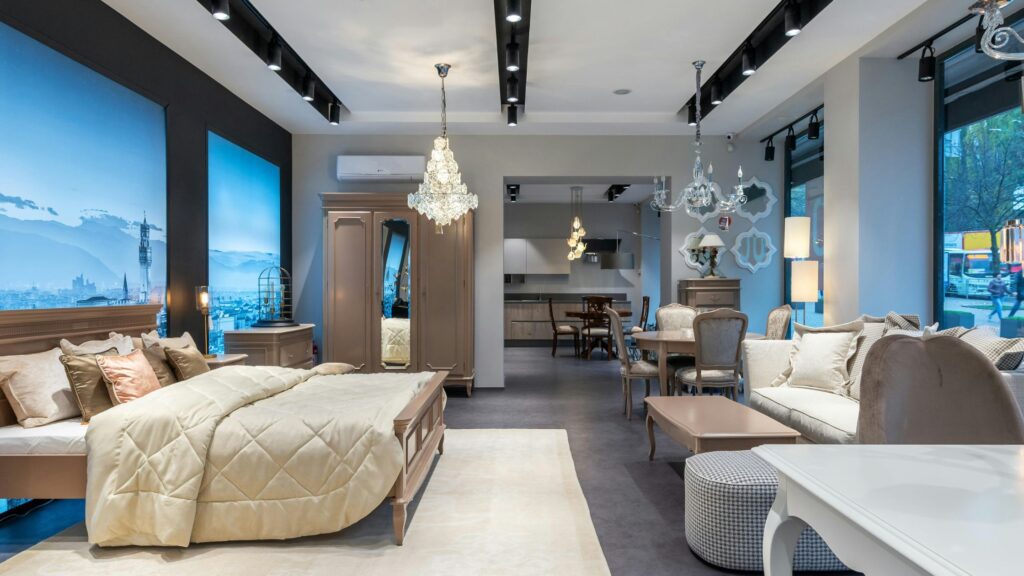
Would you want to know what virtual staging in real estate is? Real Estate Virtual Staging is a contemporary marketing strategy that involves the use of online software to add furniture to the photos of vacant rooms.
Unlike physically renting and furnishing a space, designers employ photo editing programs to produce lifelike interior images, giving prospective buyers an idea of what a space could become.
This is particularly useful in vacant and renovated listings, as well as listings that focus on a particular aesthetic.
With more buyers going online to start their houses, the ability to capture their attention with strong imagery has become an essential part of the equation.
Empty, plain rooms make weak or no impression; staged photographs reveal the possibilities of using the space.
Virtual staging is a transformation that does not present a substantial financial burden to the owner and carries no labor.
Virtual staging is helping agents, homeowners, and developers reduce their marketing expenses, limit listing duration, and increase exposure.
With an appealing visual presentation, properties will stand out in the online marketplace, which has become flooded, and pique more interest among prospective buyers.
ALSO READ – What’s The Average Commission A Real Estate Agent Earns
Now, let’s get started.
How Much Does Virtual Home Staging Cost?
Virtual staging costs significantly less than conventional staging. It averages between $25 and $ 100 per photograph, depending on the complexity of the space and the quality of the provider.
This is a one-time fee, and most companies offer bulk-order discounts when multiple rooms are being staged concurrently.
Physical staging, on the contrary, can cost thousands of dollars per month, particularly in the cases of furniture rental and labor.
Since virtual staging does not involve delivery, setup, or insurance, the price remains low with no sacrifice in visual attractiveness.
Customization options are available in some companies, which can increase the total cost. For example, it is possible to select from various design styles, including minimalist, farmhouse, contemporary, or luxury.
Additional fees may also be incurred for the edits and revisions. Nonetheless, virtual staging, despite its improvements, remains a very cost-effective method of displaying a house in the best possible light.
How Long Does Virtual Staging Take?
Virtual staging usually has a short turnaround time. Most professional services provide results between 24 and 72 hours after they have been given the photographs.
Others have the option of express delivery at an additional cost, which delivers edited photos within a business day.
The schedule may vary depending on the number of photographs being staged and the intricacy of each room.
A basic living room can be completed in less than a day, whereas a total set of rooms with special requests may take longer.
Depending on the need for revising, additional day(s) can be added to the process.
The efficiency of virtual staging lies in the fact that it does not need to deal with physical properties.
As long as the photos are sharp and of good angles, the design team can get started with them right away.
This pace enables agents to expedite the publication of listings, particularly in fast-moving markets where time is a critical factor.
ALSO READ – Why To Invest In Dubai Real Estate
What Is The Purpose Of Staging?
Staging is primarily carried out to enable prospective buyers to envision themselves occupying a space.
Staging, whether in Reality or virtually, takes bare or outdated rooms and turns them into welcoming spaces that showcase exactly what a home can be.
It highlights the design, portrays how furniture can be arranged, and helps the buyer emotionally connect with the house.
Homes that are not staged usually appear bare and lifeless in photographs. This may result in an extended time on the market or a reduced bid.
Staging compensates for this by introducing a feel of coziness and purpose to it.
For example, it may demonstrate how a small bedroom can be converted into a home office or how an open-concept living room can be transformed into a dining space and a lounge.
Good staging does not imply illusion. It is about inspiration. When buyers can get a clear idea of how the space can accommodate their lifestyle or design tastes, they are more likely to schedule a viewing or make a purchase.
What Is The Difference Between Staging And Live?
The most notable distinction between staging and live is that staging can be defined as the presentation of a property with furnishings and decor, both in Reality and virtually.
In contrast, a live property is presented as-is without enhancement. The live presentation can include a visit to the vacant or staged house, just as it is, without any changes or decorative fixes, to make it attractive in a marketing presentation.
In traditional staging, the home is filled with actual furniture. Digital furniture is also added to digital images in virtual staging.
Their purpose is the same (improving perceptions upon first sight), yet virtual staging can be seen in photos, whereas it remains unseen in person.
There are certain cases when buyers develop a disconnection when they notice that a photo, which is virtually staged, varies extensively compared to what they see in Reality.
This is why agents typically include a note to mark images that have been digitally enhanced. The advantage of showing live is that prospective buyers would get a feel of the staged space.
However, virtual staging is cost-effective and on-demand, particularly when the seller is out of town or the home is vacant.
ALSO READ – What Is The Consumer Guide In Real Estate
How Do You Virtually Stage A Room?
The creation of a virtual staged room begins with the use of high-resolution photographs of an empty room.
These photos ought to be captured at such angles where the layout, natural lighting, and architectural features are captured as much as possible.
The images are ready and transmitted to a virtual staging company or a graphic artist who specializes in interior imagery.
The designer uses photo editing software to add furniture, rugs, lighting, wall art, and other decorative elements to make the room more interesting.
The availability of several services enables the configuration of the style to suit the desired market or neighborhood image.
The designer carefully manipulates shadows, reflections, and proportions to ensure that the additions appear realistic and natural.
The results are provided to the agent or homeowner to be used in listings, brochures, or social media once the design is complete.
Clients can also ask providers to make adjustments, such as changing the colors or arrangement of furniture, to better fit their marketing strategy or buyer feedback.
ALSO READ – How Long Does It Take To Be A Real Estate Agent In Texas
Final Thought
Virtual staging has turned out to be a game changer in the current real estate industry, taking into consideration that property listing through the Internet offers an affordable solution in ascertaining that the listing will be visible and will capture the attention of interested buyers.
It also provides an opportunity for the sellers to show their homes at their best without the difficulty and expense of physical staging.
Quick turnarounds, realistic visualizations, and customizable styles make virtual staging fill the gap between empty rooms and a buyer’s imagination.
In this ever-changing online market, this digital solution is already becoming applicable to both agents and homeowners.